
PRAXIS A-P: Asian brands look to turn cultural influence into global success
Soft power can open doors, but lasting success depends on local understanding and resisting the temptation to export established playbooks.

For decades, global brand expansion was largely a one-way street dominated by Western multinationals entering Asian markets. Today, the dynamic has fundamentally shifted. From green-technology startups to century-old financial institutions, Asian brands are asserting themselves on the global stage. But they are finding that expanding internationally is not simply a matter of scaling product distribution, but of navigating cultural influence, building institutional trust, and unlearning entrenched corporate playbooks.
Framing this shift, Zsofia Balatoni, chief strategy officer at Singapore-based consultancy Rothman, argued that the global rise of Asian brands is intrinsically linked to outward cultural soft power. Citing consumer phenomena ranging from bubble tea chain Chagee and skincare brand Laneige to K-pop, K-dramas, and BYD electric vehicles, Balatoni pointed out that commercial presence brings a measurable cultural footprint. Drawing on five years of research surveying 12,000 consumers across Central and Eastern Europe, her findings revealed that country of origin is a more critical factor in purchasing decisions than online reviews or even brand name alone, trailing only price and word-of-mouth recommendations.
"Asian brands are here, Asian brands are rising, and it's not only about the brands," Balatoni explained. "These brands also have a cultural impact, and this cultural impact is actually measurable". Her research demonstrated rising consumer trust across Asian nations, with South Korea recording the fastest trust growth, China steadily closing its reputation gap with the United States, and Japan surpassing the US in overall regional reputation. "Brands create myths. They create identities, they create communities," she added, noting that positive cultural impact must be driven through everyday business practices rather than bolt-on initiatives, a concept she termed the Human Sustainability Imperative.
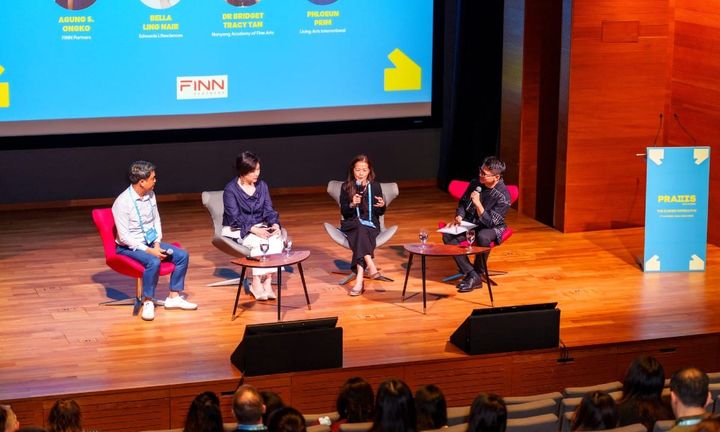
While cultural tailwinds provide momentum, operationalising global growth presents distinct hurdles for both startups and well-established companies, as evidenced in a panel moderated by Kelly Johnston, COO of Sandpiper. Ash Lim, vice president of global marketing and communications at AIoT and energy sustainability company Univers, and Fritz Quinn, managing director of corporate communications (Asia ex-Japan) at Nomura, contrasted the operational realities of scaling from different ends of the corporate spectrum. For a Singapore-headquartered startup like Univers, investment in platforms like Davos and COP, and partnerships with major sustainability think-tanks helped build credibility early on.
"When you're a startup, you don't have the luxury of time," Lim said. "You're a small fish in the ocean... you need that level of aggression to really cut through all the big boys. We basically have to keep waving our hands and say, 'hey, this is us'". Lim highlighted Singapore’s neutral reputation as "the Switzerland of the East" alongside strong support from government agencies like EDB and Enterprise Singapore as critical structural advantages. In contrast, Quinn, drawing on two decades at American Express prior to joining Japan’s 100-year-old Nomura, emphasised the difficulty of overcoming institutional inertia in established organisations. "Newton's first law is the first law for a reason," Quinn observed. "Overcoming inertia is really, really hard".
Both speakers warned against applying rigid formulas to diverse global markets. Quinn noted that Western firms entering Asia frequently fail by treating the region as a monolith, a mistake Asian brands must equally avoid when expanding outward. Success, he argued, requires open chequebooks, localised strategy, and genuine patience. "Position things in terms of how am I benefiting the market that I'm going into, not what am I going to get out of it," Quinn advised. "Firms that enter chasing population scale without understanding the market rarely succeed".
For Lim, entering new global categories required complete intellectual humility. When joining Univers from enterprise tech giants SAP and Oracle, management gave her six months solely to listen and learn before executing strategy. "Everything that you think you know, just throw it out the window. It doesn't apply," Lim urged. "You really need to listen to the market". Managing geopolitical friction, Quinn added, similarly comes down to fundamental discipline: "eliminate the unforced errors... be respectful, be present, and don't try to overpromise what your brand is".
Ultimately, as Asian brands redefine global commerce, communicators must balance technological adaptation with foundational principles. Lim cautioned against overusing buzzwords, noting that brands should "stop pushing AI into everyone's face" and focus on governance and social responsibility. Quinn echoed the sentiment, emphasising that while technology evolves, core comms practice remains irreplaceable. "AI can assist but cannot create art," Quinn concluded. "Focus on the fundamentals of PR and remember that these things work".

Comments ()