
PRAXIS MENA: CCO role recalibrates as strategy, data & judgement converge
Mubadala CCO Brian Lott and former UK government communications chief Alex Aiken highlighted how communications leadership is evolving toward greater visibility, judgement and strategic responsibility.
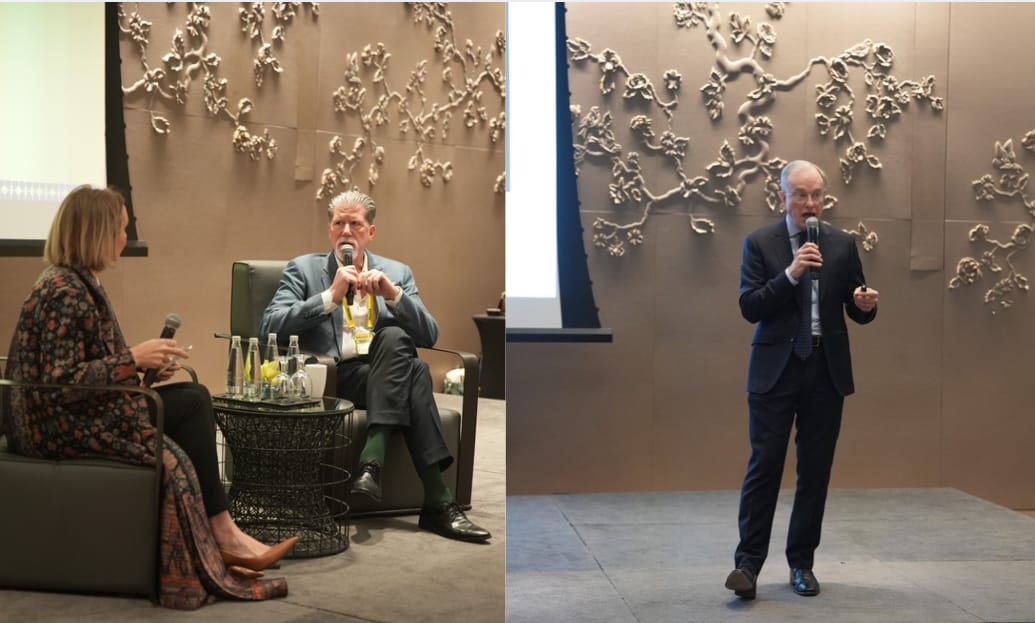
The multi-faceted evolution of communications leadership was brought into sharp focus at PRAXIS MENA on Tuesday, where two of the region's top specialists explored the importance of both professional judgment and data, in an era marked by disorientation around AI, disinformation and geopolitical complexity.
In separate sessions at the Abu Dhabi event, former UK government communications head Alex Aiken and Mubadala CCO Brian Lott discussed why comms leaders cannot shirk their responsibility to speak up inside executive rooms, despite what Aiken described as a "reluctance to meet the future" across the public relations industry.
Not that organisations must respond to everything. "Sometimes strategic silence is more effective than saying something," noted Aiken. But neither should communicators forget the crucial value they can bring to their organisation's overall policy and strategy objectives.
"Yes, be data-driven and knowledgeable about what you’re going to talk about, but don’t forget your intuition," said Lott, during a conversation with outgoing MEPRA chairperson Kate Midttun. "If you know something is in the best interest of your institution, don’t stay silent. You may not win the argument, but at least you will have said your piece. That’s why people look to you for an answer."
Aiken, meanwhile, warned that the industry continues to fall short in terms of strategy. Quoting a British Army maxim that "strategy is when the ends, ways and means come together", he noted that it fails "when the ends and means are out of sync".In response to audience questions, he indicated that as communicators, being able to present compelling numbers as part of a strategy or story "increases your credibility tenfold".
While numbers are crucial, Lott reminded a room full of industry leaders that "intuition is what got all of us here," while outlining the broad shifts he has seen during his eventful 14-year tenure as Mubadala CCO.
In particular, Lott pointed to the rise of what he called "institutional diplomacy", a model in which communications leaders move from behind-the-scenes advisors to visible representatives of their organisations in the world.
"I always believed the CCO is best in the shadows of conversations — that has completely changed," he said. "What I underestimated is your representation of the brand as you interact with partners both during work hours and after work hours. Particularly here, you can really inhabit the brand in terms of your own personal behaviour."
There is, added Lott, "a power in that as the communications head that executives don’t have," which is reshaping how influence is exercised inside and outside the organisation.
That ability to influence corporate discourse is becoming increasingly critical in the region, noted Aiken. "We tell some great stories in the Emirates," he said, while suggesting that relentless positivity can be counterproductive. "Accepting that a good story has a challenge and confrontation is an important part of telling that story."
Strong storytelling, continued Aiken, remains the most powerful "antidote to disinformation". "If you tell your story well, it gives you a fighting chance against bots and trolls," he said, adding that in the UAE, "the pace of improvement in communications is quickening", driven by its emergence as a global centre.
For Mubadala, that evolution is being underpinned by a significant elevation in local communications capability. Lott said the biggest change over the past 15 years has been the sophistication of talent built inside the Emirate. Two-thirds of his team are now Emirati nationals, he noted, capable of operating at the highest global level. "These are world-class communicators who can go to a place like Davos and hold their own with the top hundred companies in the world."
Developing that human capital is both a professional and a national imperative, Lott added, explaining that it is what drew him to the UAE and what continues to keep him there. "Why I came here and what keeps me here is developing that human capital for the next generation," he said.
In a small country with a limited population, he argued, the ability to build elite communications capabilities at home is essential, particularly as international companies increasingly turn to the UAE for partnership and support. "What we’re building here isn’t like anywhere else in the world," Lott said. "It’s not only a vision for a diversified economy."



Comments ()